

2026-06-26T12:17:46
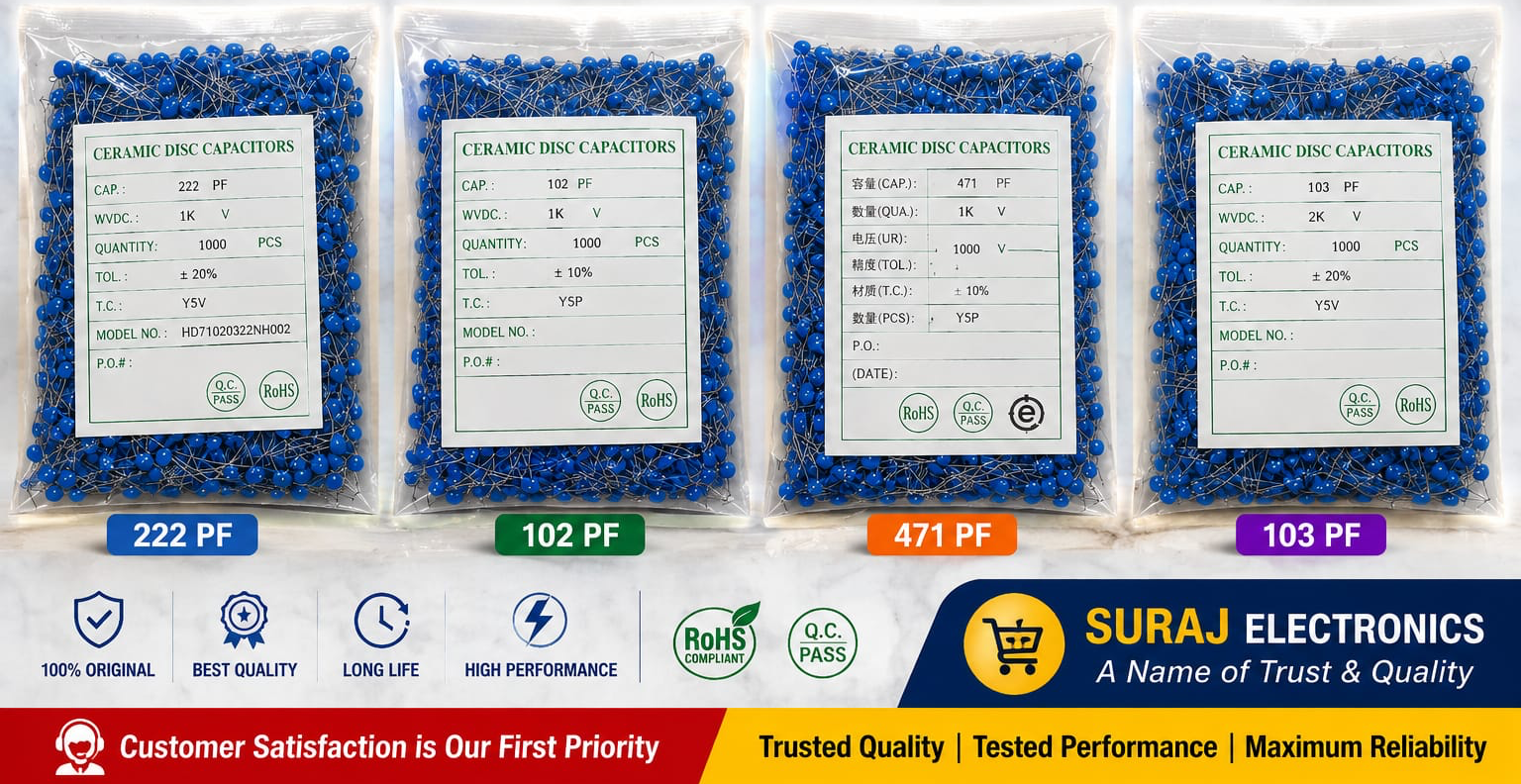
These are through-hole, non-polarized capacitors commonly used in power supplies, EMI filtering, SMPS circuits, televisions, LED drivers, and general electronic equipment. Product Specifications Capacitance Code Capacitance Voltage Rating Tolerance Dielectric Quantity 222 2, 200 pF (2.2 nF-0.0022 µF) 1 kV DC ±20% Y5V 1000 pcs 102 1, 000 pF (1 nF -0.001 µF) 1 kV DC ±10% Y5P 1000 pcs 471 470 pF 1 kV DC ±10% Y5P 1000 pcs 103 10, 000 pF (10 nF - 0.01 µF) 2 kV DC ±20% Y5V 1000 pcs The standard three-digit capacitor codes are decoded using the EIA marking system, where the first two digits are significant figures and the third digit is the multiplier in picofarads. Features * High-voltage ceramic disc construction * Non-polarized design * Through-hole radial leads * Excellent high-frequency performance * Low dielectric loss * Compact and lightweight * RoHS compliant * Quality control (QC) tested Applications * SMPS power supplies * LED drivers * Television and monitor circuits * High-voltage power circuits * EMI-RFI suppression * Switching power supplies * Industrial control equipment * Consumer electronics * Electronic repair and servicing * General-purpose PCB assemblies Advantages * Reliable high-voltage insulation * Stable electrical performance * Long operating life * Cost-effective solution * Easy PCB mounting * Suitable for high-frequency applications Capacitor Code Reference * 471 = 470 pF * 102 = 1, 000 pF = 1 nF = 0.001 µF * 222 = 2, 200 pF = 2.2 nF = 0.0022 µF * 103 = 10, 000 pF = 10 nF = 0.01 µF SEO Keywords High Voltage Ceramic Disc Capacitor, 222 Capacitor, 102 Capacitor, 471 Capacitor, 103 Capacitor, 1kV Ceramic Capacitor, 2kV Ceramic Capacitor, Radial Ceramic Capacitor, Through-Hole Capacitor, EMI Filter Capacitor, Electronic Components, PCB Capacitor, Disc Capacitor, RoHS Ceramic Capacitor. This assortment is well suited for electronics manufacturers, repair technicians, educational laboratories, and industrial applications requiring reliable high-voltage ceramic capacitors.
Have a question? Ask here!
Required fields are marked *